
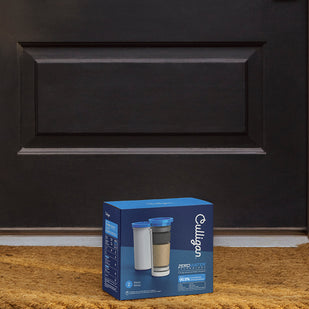

If you want less fluoride in your drinking water, the filter inside your pitcher matters more than the name on the box. Here is the short answer, how to check which filter you own, and what the certification actually covers.
The short answer
Yes, if you use a Culligan with ZeroWater Technology filter. Culligan with ZeroWater Technology pitchers and dispensers are IAPMO certified to NSF/ANSI 53 to reduce 99.7% of fluoride.
Older ZeroWater filters are not certified to reduce fluoride. These are the filters that screw into the bottom of the reservoir on pitchers and dispensers with the ZeroWater logo.
| Filter | How to recognize it | Fluoride certification |
|---|---|---|
| Culligan with ZeroWater Technology | Filter drops in from the top, Culligan logo, sliding lid | Certified to reduce 99.7% (NSF/ANSI 53, IAPMO) |
| Older ZeroWater | Filter screws into the bottom of the reservoir, ZeroWater logo, lift-off lid | Not certified to reduce fluoride |
Shopping for fluoride reduction? Compare water filters certified to reduce fluoride, or see how Culligan with ZeroWater Technology water filter pitchers compare with other pitchers.
Shop Culligan with ZeroWater Technology
How to tell which filter you have
The two filters are not interchangeable, so check before you buy replacements.
You likely have Culligan with ZeroWater Technology if the filter drops in from the top of the upper reservoir, the pitcher or dispenser has the Culligan logo, and the lid slides open for refilling.
You likely have an older ZeroWater system if the filter screws into the bottom of the upper reservoir, the unit has the ZeroWater logo, and you lift off the whole lid to refill.
Still not sure? Use the filter compatibility guide. If you own an older system and want certified fluoride reduction, you will need a Culligan with ZeroWater Technology pitcher or dispenser, because the new filter does not fit older units.
What fluoride is and how it gets into tap water
Fluoride is a naturally occurring mineral found in rock, soil and groundwater. Many U.S. water systems also add it to help prevent tooth decay. In 2020, 72.7% of people served by community water systems had access to fluoridated water, according to the CDC.
Where fluoride is added, the U.S. Public Health Service recommends a level of 0.7 mg/L. The EPA's enforceable limit for public water systems is 4.0 mg/L, and its non-enforceable secondary standard of 2.0 mg/L is set to prevent tooth discoloration. Natural levels in some wells and regions run higher.
Why some households choose to reduce fluoride
Fluoride's benefit for teeth is well established, and the CDC and major dental groups support community water fluoridation. Concerns center on higher exposures:
- Dental fluorosis: white spots or streaks on enamel in children who take in too much fluoride while their teeth are forming.
- Skeletal fluorosis: joint stiffness and bone changes tied to long-term exposure to high fluoride levels, mostly where natural fluoride is high.
- Neurodevelopment: a 2024 National Toxicology Program review concluded, with moderate confidence, that drinking water above 1.5 mg/L of fluoride is associated with lower IQ in children. That is about twice the recommended fluoridation level.
Policy is moving too. The EPA started an expedited review of the science on fluoride in drinking water in April 2025 and released its preliminary assessment plan in January 2026. Utah and Florida ended community water fluoridation in 2025.
Filtering fluoride is a personal choice. If you have young children, ask your dentist how to balance fluoride from water, toothpaste and other sources.
How the Culligan with ZeroWater Technology filter reduces fluoride
Culligan with ZeroWater Technology uses a 5-stage filter with an ion exchange stage that captures dissolved ions, including fluoride. In certification testing by IAPMO R&T against NSF/ANSI 53, water containing 8.0 mg/L of fluoride was filtered to 1.0 mg/L or less, an average reduction of 99.7%.
You can check the numbers in the Performance Data Sheet or see all of our certifications.
What else the filter is certified to reduce
The same filter is certified to reduce lead (up to 98.9%), Total PFAS (99.7%), chromium 6 (up to 99.5%), mercury (up to 96.6%) and nitrate (99.1%) under NSF/ANSI 53, and chlorine (99.4%) under NSF/ANSI 42.
Keep fluoride reduction working
Certified performance assumes you replace the filter on schedule. Each Culligan with ZeroWater Technology filter is rated for 20 gallons. Keep spares on hand with Culligan with ZeroWater Technology replacement filters, or subscribe and save 5% so a new filter arrives before you need it.
Shop Culligan with ZeroWater Technology pitchers and dispensers
Fluoride and filtration FAQs
Does boiling water remove fluoride?
No. Boiling evaporates water and leaves fluoride behind, so it can slightly raise the concentration.
Do gravity water filters reduce fluoride?
It depends on the system. Culligan with MaxClear Technology gravity water filter systems are not currently certified to reduce fluoride. For certified fluoride reduction, choose Culligan with ZeroWater Technology.
How do I find out how much fluoride is in my water?
If you are on a public water system, check your annual Consumer Confidence Report. If you use a private well, have your water tested by a certified lab.
Will the filter work with my older ZeroWater pitcher?
No. Culligan with ZeroWater Technology filters only fit Culligan with ZeroWater Technology pitchers and dispensers. The compatibility guide shows how to tell them apart.
Sources
- Culligan with ZeroWater Technology Performance Data Sheet, IAPMO R&T, NSF/ANSI 42, 53 and 401
- Water Fluoridation Data and Statistics, Centers for Disease Control and Prevention
- U.S. Public Health Service Recommendation for Fluoride Concentration in Drinking Water, Public Health Reports, 2015
- National Primary Drinking Water Regulations and Secondary Drinking Water Standards, U.S. EPA
- Fluoride Exposure: Neurodevelopment and Cognition, National Toxicology Program, 2024
- EPA Will Expeditiously Review New Science on Fluoride in Drinking Water, U.S. EPA, April 2025
- EPA Announces Next Step in Review of Fluoride, U.S. EPA, January 2026


