


Lead contamination in drinking water has been a known public health concern for decades, but the Flint water crisis in 2014 pushed it back into the national conversation. That crisis reinforced what water professionals have long understood: lead in drinking water comes from aging plumbing infrastructure, not from the treatment plant.
Millions of homes across the United States are still connected to municipal water systems through lead service lines. Even homes without a lead service line can have lead-containing plumbing inside, which can leach lead into tap water.
Recent regulatory changes have renewed attention on the issue. In October 2024, the EPA finalized updates to the Lead and Copper Rule, known as the Lead and Copper Rule Improvements (LCRI). You can read a full breakdown in our guide to the EPA Lead and Copper Rule. While these changes are meaningful progress, replacing in-ground infrastructure across thousands of communities will take years, so understanding how lead enters water and how to reduce exposure still matters today.
Quick summary
- What is lead? A toxic metal historically used in plumbing materials such as service lines, solder, and brass fixtures.
- How does it contaminate water? Lead contamination almost always comes from plumbing materials that contain lead, not from the water source.
- Health concerns: Lead exposure is linked to developmental delays and learning problems in children, and to cardiovascular and kidney effects in adults.
- What you can do: Testing your water and using filtration certified to reduce lead are two of the most effective steps a household can take.
What is lead?
Lead is a naturally occurring heavy metal that builders historically used in plumbing because it is soft, corrosion-resistant, and easy to work with.
For much of the 20th century, lead was commonly used in:
- Water service lines connecting homes to municipal systems
- Lead-based solder used to join copper pipes
- Brass plumbing fixtures and valves
- Household paint and gasoline additives
Although regulators phased out many of these uses beginning in the late 20th century, older infrastructure still contains significant amounts of lead.
How does lead get into drinking water?
Lead primarily enters drinking water through corrosion of plumbing materials. Utilities work to limit corrosion by adding corrosion-control chemicals, most commonly orthophosphate, which forms a protective mineral coating inside pipes that reduces how much lead dissolves into the water.
Lead can enter water in two primary forms.
Dissolved lead
Small amounts of lead can dissolve directly into water when plumbing materials corrode.
Particulate lead
Lead can break loose as tiny particles when corrosion destabilizes plumbing materials, or when pipes are disturbed during plumbing work or construction. These particles can cause sudden spikes in measured lead levels.
What plumbing materials contain lead?
Although most lead-containing or lead-leaching plumbing materials have been regulated by 2026, many older materials still serve homes across the country.
Lead service lines
Service lines are the pipes that connect homes to municipal water mains. Millions of lead service lines were installed during the early and mid-20th century, and somewhere between 4 and 9 million remain in service today.
Lead solder
Until the mid-1980s, lead-based solder was commonly used to join copper pipes in residential plumbing, typically containing 40 to 50 percent lead. Because solder joints appear throughout a plumbing system, they are a potential source of lead in the home. The 1986 amendments to the Safe Drinking Water Act banned lead solder in potable water systems, but homes built or renovated before that time may still contain these high-lead joints.
Brass fixtures and valves
Many faucets, valves, and fittings are made from brass alloys that historically contained lead, which manufacturers added because it made the metal easier to machine.
| Plumbing component | Historical standard | Current standard | Key policy change |
|---|---|---|---|
| Lead solder | Typically 40 to 50 percent lead | Lead solder banned for potable plumbing systems | Safe Drinking Water Act Amendments (1986) |
| Brass fixtures and valves | Up to 8 percent lead allowed in brass labeled "lead-free" | 0.25 percent weighted-average lead across wetted surfaces | Reduction of Lead in Drinking Water Act (2011, effective 2014) |
Because plumbing systems often stay in service for decades, many homes still contain components installed under earlier standards. As a result, lead can still enter drinking water even when newer plumbing meets modern "lead-free" requirements.
Why you should care
The Centers for Disease Control and Prevention (CDC) and the American Academy of Pediatrics (AAP) agree there is no safe level of lead exposure for children, because even small amounts can interfere with brain development.
Research has linked lead exposure to:
- Reduced IQ and learning difficulties in children
- Behavioral and developmental delays
- Increased blood pressure and cardiovascular risk in adults
- Kidney damage and reproductive effects
Children are especially vulnerable because developing nervous systems are more sensitive to lead, but exposure should be avoided across all age groups.
Which buildings are most at risk?
The buildings at highest risk of lead contamination include:
- Homes built before 1986, when lead solder was widely used
- Homes connected to lead service lines
- Older plumbing systems with brass fixtures containing lead
- Buildings where water sits stagnant in pipes for long periods, such as schools
Private well owners face a different situation. Unlike municipal systems, private wells are not regulated by the EPA, so well owners are responsible for testing and managing their own water quality. Testing water at the tap is the only reliable way to know whether lead is present in a specific household's water.
How is lead regulated in drinking water?
Federal regulation of lead in drinking water is governed by the EPA Lead and Copper Rule (LCR). In October 2024, the EPA finalized the Lead and Copper Rule Improvements (LCRI), which introduced several major changes: lowering the lead action level from 15 parts per billion to 10 parts per billion, requiring utilities to identify all lead service lines, and mandating the replacement of lead service lines nationwide. Most systems must complete replacement over roughly a ten-year timeline, with national efforts extending into the mid-2030s.
For a deeper explanation of how the action level works, why it isn't the same as a household safety guarantee, and how cities sample and calculate results, see our guide to the EPA Lead and Copper Rule.
How to reduce your exposure to lead
Regulations change slowly and don't always keep pace with the science, so it's worth taking steps to reduce lead exposure at home.
Use filters certified to NSF/ANSI Standard 53 for lead reduction
Look for filtration systems certified to NSF/ANSI Standard 53 for lead reduction. Certification is granted contaminant by contaminant, so review the product's performance data sheet to confirm the system is specifically certified to reduce lead. You can learn more about lead in drinking water and which filters are certified to reduce it.
Run your faucet before using the tap
If water has been sitting in your pipes for several hours, running the tap for two to three minutes before drinking or cooking can meaningfully reduce lead levels by flushing out the stagnant water.
Understand your lead risk today
Lead in drinking water is primarily a legacy infrastructure problem. Many homes still contain plumbing installed under older standards, and replacing those systems takes time. Until that work is finished, understanding your plumbing, testing your water, and using properly certified filtration can help reduce exposure and give your household more control over its drinking water.
If you're ready to address lead at the point of use, explore filtration built around tested contaminant reduction:
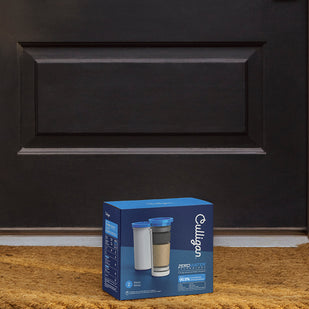
- For pitcher and dispenser filtration: Culligan with ZeroWater Technology water filter pitchers
- For countertop gravity systems: Culligan with MaxClear Technology gravity water filter systems
- Shop all Culligan with MaxClear Technology gravity water filter systems
Lead in drinking water FAQs
Where does lead in drinking water come from?
Lead in drinking water almost always comes from plumbing materials rather than the water source. It enters when lead service lines, lead solder, or brass fixtures corrode, and it can appear as dissolved lead or as particles released when pipes are disturbed.
Which homes are most at risk of lead in their water?
Homes built before 1986, homes connected to lead service lines, older systems with leaded brass fixtures, and buildings where water sits stagnant for long periods are at the highest risk. Testing at the tap is the only reliable way to confirm whether a specific home has lead.
Is there a safe level of lead in drinking water?
No. The CDC and the American Academy of Pediatrics agree there is no safe level of lead exposure for children, and the EPA's health-based goal for lead in water is zero.
How can I reduce lead in my tap water?
Use a filter certified to NSF/ANSI Standard 53 for lead reduction, confirm on the performance data sheet that it is certified to reduce lead specifically, and run the tap for two to three minutes after water has been sitting in the pipes.
Sources
- U.S. EPA — Basic Information About Lead in Drinking Water
- U.S. EPA — LCRI Questions and Answers
- NRDC — Analysis of EPA lead service line estimates


